
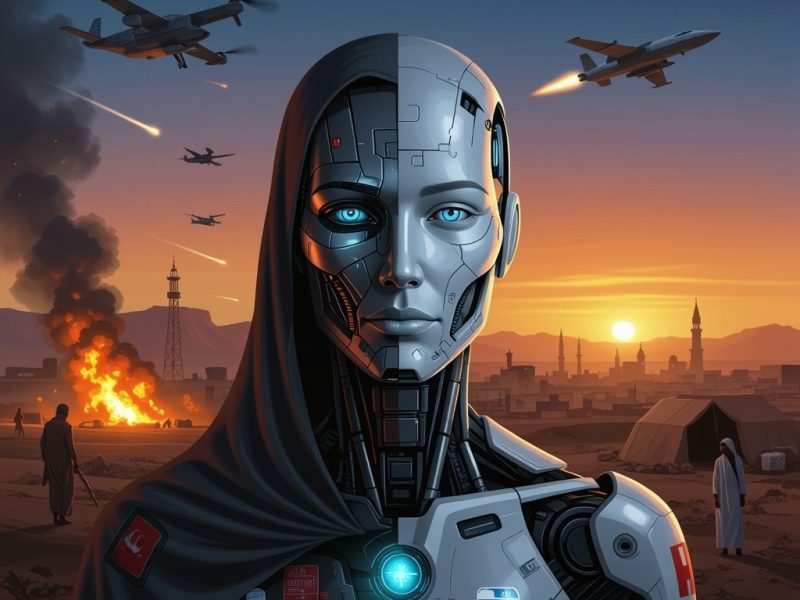
Introduction: When AI Meets Protest
It was supposed to be another landmark keynote at Microsoft Build 2025, an event showcasing innovation, breakthroughs, and the digital future. But what unfolded on stage was something unexpected. A Microsoft engineer interrupted CEO Satya Nadella mid-sentence, accusing the tech giant of complicity in the Gaza conflict. The phrase that echoed across the world: “You are building AI to kill Palestinians.”
More than a shocking disruption, it forced the world to ask difficult questions. As AI becomes intertwined with defense contracts, surveillance, and humanitarian logistics, where do we draw the ethical lines? And can empathy be programmed into silicon?
The Expanding Role of AI in Crisis Zones
AI is not just about chatbots and self-driving cars. Today, it plays a crucial role in conflict zones, disaster response, refugee management, and even diplomacy. From predictive models for famine to drones mapping post-earthquake devastation, AI has become a powerful, dual-use tool.
- In war zones, AI assists in surveillance and target identification.
- In refugee camps, AI helps NGOs manage logistics, track outbreaks, and optimize food distribution.
- In diplomacy, data-driven negotiation simulations help shape international responses.
Yet, these noble uses often live alongside controversial applications, blurring the line between support and control.
Satya Nadella’s Dilemma: Can Tech Stay Neutral?
Microsoft, like many tech giants, walks a fine line. On one hand, it pledges support for ethical AI, environmental responsibility, and digital equity. On the other, it signs defense contracts, contributes to military AI, and enables surveillance tools used in contested regions.
When Nadella was interrupted, it symbolized the breaking point of that contradiction. Can a company be both a humanitarian leader and a defense contractor? Can you create tools of empathy and instruments of war using the same algorithms?
AI and the Ethics of Engagement
Dual-Use Technology
Many AI tools are dual-use. A facial recognition system that helps find missing persons can also track political dissidents. A drone that delivers medicine can also deliver bombs. The core technology is neutral; the intent is not.
Autonomy vs. Accountability
Autonomous weapons raise another red flag. As machines make decisions in real-time, accountability becomes murky. Who’s responsible if an AI misidentifies a target? The developer? The commander? The algorithm?
Bias in AI Decision-Making
AI is only as fair as the data it’s trained on. In humanitarian scenarios, bias can mean life or death. A flawed refugee risk assessment system might unfairly deny aid. A miscalibrated predictive policing tool might target already marginalized communities.
Case Study: AI in Gaza and the Middle East
The ongoing crisis in Gaza has spotlighted how AI is used—and misused. Reports indicate the use of AI-powered drones for surveillance, facial recognition for movement tracking, and predictive policing for crowd control. While governments claim these systems maintain order, critics argue they infringe on human rights and deepen the conflict.
NGOs, on the other hand, are leveraging AI to:
- Predict outbreaks of waterborne diseases in camps.
- Coordinate humanitarian supply chains amidst conflict.
- Analyze satellite imagery to identify destroyed infrastructure.
The tension lies in who controls the AI—and for what purpose.
Silicon with Soul: Can Empathy Be Programmed?
The dream of “empathetic AI” is seductive. Imagine an algorithm that doesn’t just process data, but understands suffering. AI that prioritizes aid to the most vulnerable, flags violations of international law, or supports mental health in trauma zones.
We’re not quite there yet. But steps are being taken:
- Ethics Frameworks: Organizations like the IEEE and UNESCO are developing AI ethics protocols.
- AI for Good: Initiatives by the UN and World Economic Forum aim to use AI to meet global development goals.
- Empathetic Algorithms: Researchers are exploring affective computing—algorithms that recognize and respond to human emotions.
Voices from the Frontlines
The Microsoft protest wasn’t an isolated act of rebellion. Across the tech world, engineers, designers, and AI ethicists are speaking out. The “Tech Won’t Build It” movement, sparked years ago by opposition to Google’s Project Maven, is resurging. Workers want transparency, accountability, and moral clarity.
They’re not anti-technology—they’re pro-humanity.
The Future of Humanitarian AI
As we move deeper into the 21st century, AI’s role in crises will only expand. But we must move beyond the binary of savior or villain. AI is a tool—and its ethical compass comes from us.
Some possible paths forward:
- Open Humanitarian AI: Open-source AI tools for NGOs, free from military funding.
- Ethical Licensing: Developers can restrict their AI from being used in warfare.
- AI Watchdogs: Independent bodies that audit AI use in conflict zones.
The goal isn’t to halt AI development—it’s to align it with our highest values.
Conclusion: The Moral Algorithm
AI doesn’t have a heart. But the people building it do.
The future of humanitarian AI isn’t about faster processing or better data—it’s about courage. Courage to stand up, like the Microsoft protestor. Courage to question contracts, challenge norms, and embed ethics into every line of code.
If we succeed, we won’t just build smarter machines. We’ll build a smarter humanity.
