
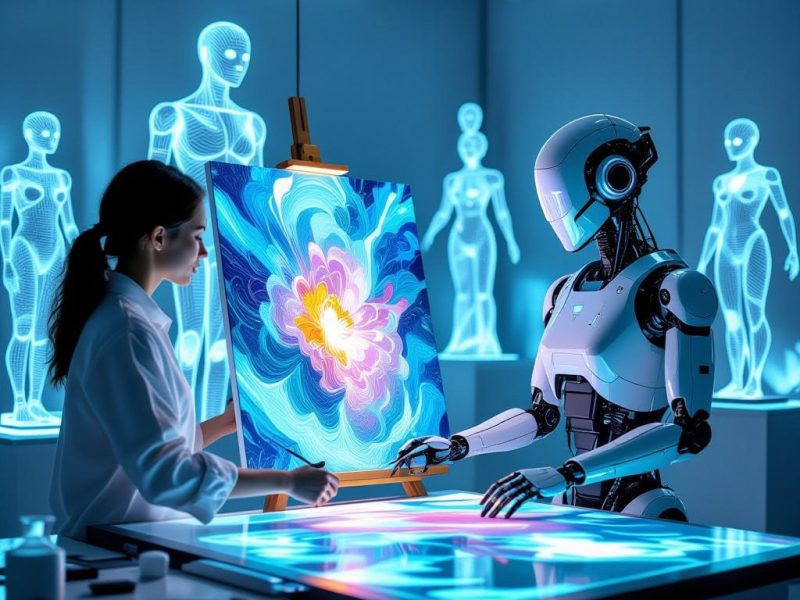
Introduction: The Canvas Has Changed Forever
Welcome to the dawn of a new era in human expression—a time where imagination meets machine, and creativity becomes a collaboration between biology and code. In the heart of this revolution lies artificial intelligence, no longer just a tool of analysis or automation, but a vibrant co-creator. The year is 2025, and the very definition of “artist” is expanding beyond imagination.
This blog delves into how AI is reshaping the creative world—from painting and poetry to music, filmmaking, and storytelling. We’ll explore the philosophical, artistic, and practical implications of this shift and why this might just be humanity’s next great Renaissance.
1. The Rise of the Machine Muse
Once confined to data analysis and automation, AI is now inspiring human creativity in unexpected ways. Tools like DALL·E, Midjourney, ChatGPT, RunwayML, and Soundraw are not replacing artists—they’re becoming their muses.
- Visual Artists: Use generative AI to explore styles never seen before—hyper-surreal, post-human, or mathematically perfect compositions.
- Writers: Craft story arcs with language models that simulate thousands of narrative patterns and tones.
- Musicians: Remix genres and compose entire symphonies with the help of AI beat-makers and composition assistants.
AI doesn’t fatigue. It doesn’t judge. It iterates tirelessly—sparking creativity in artists by offering them infinite combinations of “what if.”
2. Redefining Authorship and Originality
What does it mean to “create” in the age of intelligent machines? Who owns an AI-generated artwork? The lines are blurry—and philosophers, artists, and legal scholars are grappling with the implications.
- Is originality still meaningful when an algorithm can generate 1000 variations in seconds?
- Should AI be considered a co-author or merely a brush in the hand of the artist?
- Do algorithms have creative intent—or are they just reflections of our own ideas?
In 2025, creators are learning to embrace a new kind of authorship—one where process, curation, and human intent matter more than sole authorship. The artist becomes the orchestrator of machine imagination.
3. From the Canvas to Code: New Mediums of Expression
AI has unlocked artistic dimensions that never existed before. Art is no longer confined to physical canvases or digital brushes. It flows through neural networks, virtual spaces, and even wearable ecosystems.
- AI-Interactive Art: Installations that change based on audience reactions or environmental inputs.
- Immersive Story Worlds: Writers and game developers create living narratives that evolve using AI-based dialogue generation.
- Algorithmic Fashion: Designers collaborate with AI to generate wearables based on mood, weather, and cultural cues.
The mediums are expanding as quickly as the algorithms. We are no longer just artists—we are experience designers in an ever-evolving creative ecosystem.
4. The Democratization of Creativity
One of the most profound impacts of AI on creativity is access. You no longer need formal training, expensive tools, or elite connections to create stunning work.
- A 12-year-old in Nigeria can create a short film using RunwayML and distribute it globally.
- A farmer in India can write poetry with the help of GPT in his native language.
- A disabled artist can generate complex 3D sculptures using voice-guided AI tools.
This democratization empowers voices once unheard—shattering gatekeeping and opening the floodgates to a global tapestry of creative expression.
5. Collaboration, Not Competition
Despite fears of replacement, most artists are embracing AI as a collaborator rather than a competitor. The key lies in how you use it:
- AI can ideate, but it’s the human that injects soul.
- AI can mimic, but it’s the human that innovates beyond imitation.
- AI can generate, but it’s the human that curates and contextualizes.
In this symbiotic relationship, the artist becomes more than a creator—they become a conductor of creative intelligence, directing a digital orchestra of infinite potential.
6. The Rise of the Techno-Mystic: Merging Spirituality and Code
Strangely, as AI accelerates logic and reason, it also awakens deeper questions about human purpose, soul, and consciousness. Artists in 2025 are exploring this space between code and cosmos.
- AI Astrology: Tools blend Vedic knowledge with algorithmic charts to produce spiritual art and symbolism.
- Digital Rituals: NFTs become modern talismans—coded prayers or ritual tokens linked to community and intention.
- Machine-Oracles: Artists use AI to channel surreal visions and dreamscapes that blur the line between algorithm and archetype.
Welcome to the era of the techno-mystic—where sacred symbolism meets generative code in a search for higher meaning.
7. Ethical AI and Creative Responsibility
With great power comes great responsibility—and the AI creativity boom is no exception. In 2025, ethical questions are front and center:
- How do we ensure AI doesn’t reinforce biases or plagiarize existing works?
- Can we distinguish real from fake as deepfakes become indistinguishable?
- Who protects indigenous art when algorithms replicate sacred patterns?
Artists are rising as ethical leaders—pushing for transparency, consent, and cultural respect in AI-driven creations.
8. Education and the Creative Future
Creative education is undergoing a transformation. Traditional models are giving way to interdisciplinary learning:
- Art schools now teach coding alongside color theory.
- Design students learn prompt engineering and algorithmic aesthetics.
- Philosophy and digital ethics are essential for next-gen artists.
We’re witnessing the birth of the “creative engineer”—part artist, part technologist, part philosopher.
9. The Business of Creativity: New Careers and Economies
AI is spawning entirely new creative industries and monetization models:
- Prompt Designers: Professionals who specialize in crafting inputs for generative AI tools.
- AI Curators: Art directors who sift through generated outputs to create cohesive collections or campaigns.
- Creative Technologists: Developers who merge code, art, and UX to build interactive experiences.
From NFT galleries to AI poetry subscriptions, the creative economy is expanding—and it’s just the beginning.
Conclusion: Toward a New Renaissance
In the 15th century, the Renaissance birthed a cultural explosion that changed the world. In 2025, we stand on the edge of a New Renaissance—powered by neural networks instead of paintbrushes, by algorithms instead of oil paints.
But the heart of this movement remains human. AI is a mirror—a muse—a multiplier. It reflects our desires, fears, curiosities, and dreams. It expands the creative playground and challenges us to define what it means to be a creator in this new age.
So whether you’re a painter, poet, producer, or programmer—the future is wide open. Welcome to the golden age of co-creation. Welcome to the renaissance of the machine-mind union.
